
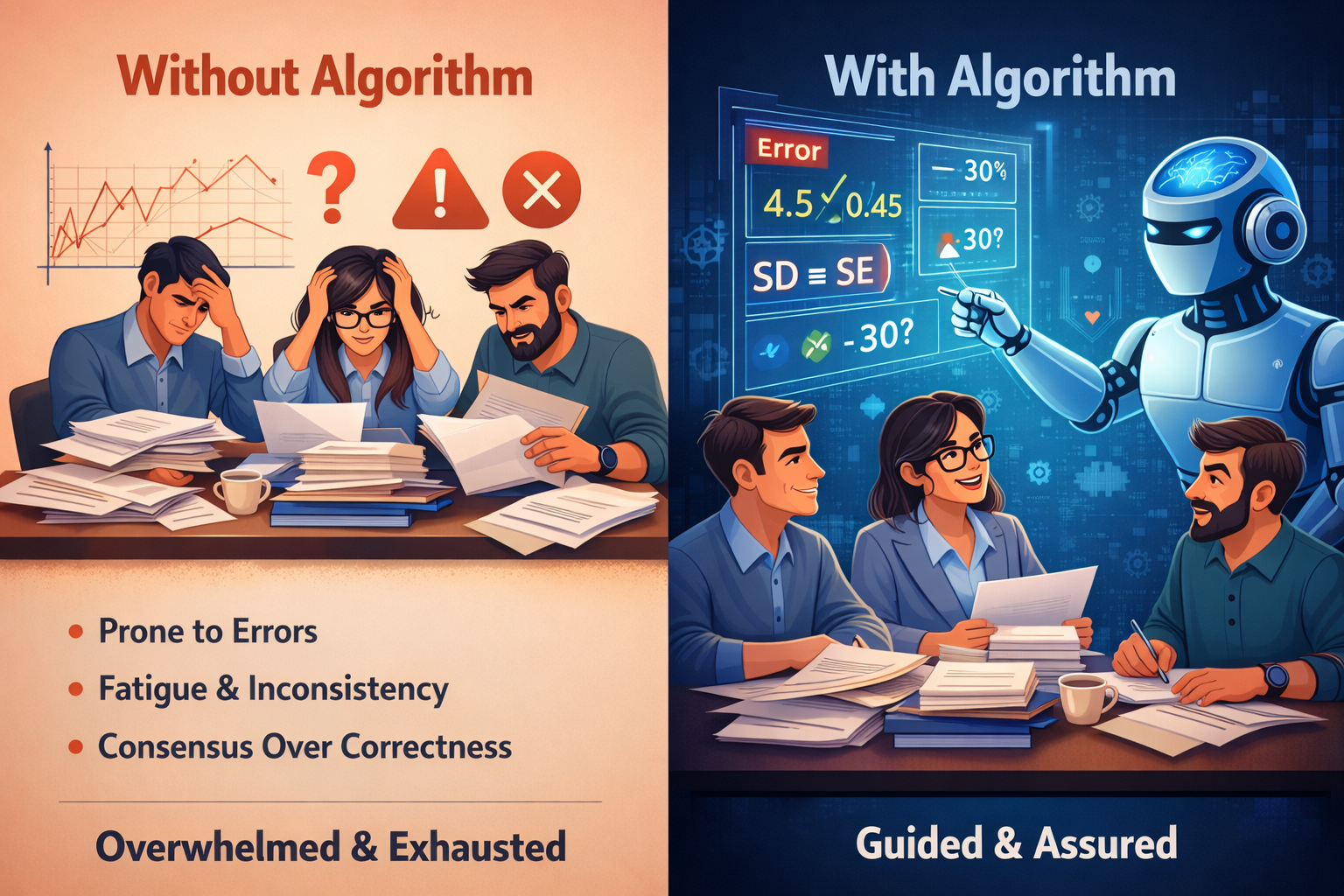
In the world of meta-analysis, we have a collective security blanket. It’s called Inter-Rater Reliability (IRR).
The ritual is a classic: We select a team of researchers, provide rigorous training on the coding scheme, and then lock them in a digital room with 100 PDFs. We tell them to extract the Means, SDs, and correlations independently. When they emerge, we run a Kappa to check for agreement and have a supervisor arbitrate any conflicts. In the "old" gold standard, we then ran the data through influence diagnostics—often, though not exclusively, using the metafor package in R to hunt for outliers that might skew the model. If the Kappa was or higher and the Cook's distance looked stable, we popped the champagne. We assumed the data was "clean."
We are wrong.
1. The Crisis of "Consensus over Correctness"
The sobering reality is that human beings are remarkably consistent at being wrong in the exact same way. If a primary study table is formatted ambiguously—say, reporting a Standard Error (SE) but labeling it as a Standard Deviation (SD)—both of your raters will likely extract the SE.
Your Kappa? A perfect 1.0.
Your Data? Garbage.
The evidence for this crisis is widespread and consistent across disciplines. Landmark audit studies, such as the Gøtzsche et al. (2007) analysis in JAMA, found that 63% of meta-analyses contained at least one significant extraction error. More recent systematic reviews, such as Mathes et al. (2017), have confirmed that error rates in data extraction typically range from 8% to as high as 63%, with "highly experienced" extractors performing no better than novices.
Perhaps most alarming is the impact on the bottom line: in high-stakes fields like urology, recent audits found that over 85% of systematic reviews contained extraction errors, and in 6.6% of those cases, the errors were severe enough to flip the statistical significance of the final result. In these instances, these "small" typos aren't just noise—they are enough to change the clinical or organizational recommendation entirely. We don't have a reliability problem; we have a truth problem.
2. Automated Validation: Why Research is the Outlier
To solve the truth problem, we have to stop treating "agreement" as the terminal goal of data cleaning. In almost every other high-stakes industry, "trusting" two people to agree on a spreadsheet would be considered a negligent security flaw.
In software engineering, this is called "Data Linting." Before code is ever allowed to run, it passes through a "linter" that flags suspicious constructs and logical inconsistencies. In finance, it’s called "Constraint Validation." You literally cannot enter a transaction into a banking database that doesn't balance; the system rejects it at the gate.
Research has traditionally operated on the "Honest Rater" model, assuming that integrity and effort are sufficient to ensure accuracy. But while the honest rater still has a critical place, the journals are catching up to the fact that effort alone cannot catch mathematical impossibilities. Statistical linting does not replace human judgment; it front-loads it. By placing geometric and probabilistic guardrails in the workflow, we allow humans to spend their time resolving flagged discrepancies rather than hunting for invisible typos.
The Journal's Shield
High-impact publishers are increasingly adopting automated "truth-checkers" to vet manuscripts before they reach a peer reviewer's desk. Tools like statcheck, for instance, already scan papers for internal statistical consistency (e.g., checking if a reported -value actually matches the reported -value).
If the journals are already using these deterministic shields to protect their reputation, it behooves us as researchers to run them on our own data first. We must move toward an Automated Cleaning Infrastructure where the "New Gold Standard" isn't just a third human, but a gauntlet of mathematical constants that cannot be argued with.
3. The HubMeta Approach: Systematic Linting
At HubMeta, our philosophy moves beyond simple "error catching." We approach meta-analysis data as a codebase that requires a rigorous build-test cycle. Our approach to linting identifies not just impossible entries (mathematical violations) but also unlikely ones (distributional anomalies), providing aggressive suggestions for the most probable human or author error.
When 100% Accurate Extraction is Still Wrong
One of the most dangerous myths in meta-analysis is that if your raters perfectly extract what is on the page, the data is "correct." In reality, "Garbage In" often starts with the primary studies themselves. Even a perfect extraction is "Garbage Out" if the original article contains:
- The SD/SE Swap: Authors frequently label Standard Errors as Standard Deviations. A perfect extraction here results in a study being weighted massively and incorrectly in your model.
- Sign Reversals: A reported correlation of that, given the context of the measures, is clearly a .
- Decimal Displacement: An entered as , or a reliability of coded as a whole number () instead of a proportion ().
- Digit Transposition: Small-print misreads where becomes .
- Internal Inconsistency: A reported -statistic that doesn't match the -value, or a mean that is mathematically impossible given the sample size ().
- The "Copy-Paste" Ghost: When authors reuse a table template but forget to update the or the for a new variable.
The Deterministic Gatekeepers: Auditing the "Nuts and Bolts"
In the HubMeta model, we don't just look for "outliers" at the end. We audit the raw components—the nuts and bolts of every effect size—against the laws of probability and geometry. Every data point is subjected to a series of "Hard Constraints" (impossible) and "Forensic Suggestions" (implausible):
- Means & SDs (Plausibility Boundaries): We check if the reported is physically possible given the scale range and the mean. On a 1–5 scale, you cannot have an of 3.0. We use GRIM (Granularity-Related Inconsistency of Means) to verify if a mean is mathematically possible given the reported . If you have 20 people, a mean of 3.12 is a literal impossibility.
- Correlations (Geometric Integrity): We move beyond bivariate checks to NPD (Non-Positive Definite) Checking. A correlation matrix is a geometric object; if the reported relationships between three variables (, and ) violate the laws of geometry—for instance, if and are nearly identical, but both are unrelated to —the data is objectively, physically wrong.
- Reliability (Consistency Tiers): We check reported alphas against both the measure’s own history and the broader construct distribution. If a rater enters for a well-validated 20-item scale, it is flagged. We use Spearman-Brown logic to test if the reported alpha, item count, and inter-item correlations form a consistent triad.
- Range & Item Counts (Scale Sanity): We flag impossible item counts (e.g., negative items) and "span" violations where the reported don't match the known properties of the scale.
- The MAD-z Filter (The "Alien" Detector): We use Median Absolute Deviation (MAD-z) to identify values that are statistically "alien" compared to the distributional plausibility of the entire project. This flags entries that are mathematically possible but practically suspect.
By the time an entry reaches the supervisor, it shouldn't just be "agreed upon"—it should be proven plausible.
4. The "Aggressive Suggestion" Engine: From Detection to Solution
Identifying a potential problem is only half the battle. In a traditional workflow, a flagged outlier leads to a frustrating, manual scavenger hunt back through the original PDF. At HubMeta, we turn detection into a solution. Our forensic scripts don't just flag a "weird" value; they perform Typogrammetry—a systematic reverse-engineering of the error.
The system doesn't use random brute force; it only considers transformations that preserve interpretability and have a low "edit distance" from the original entry. It tests the flagged value against common miscoding mechanisms to suggest not just that there is a mistake, but where it came from and how to fix it:
- Sign Flip: The system automatically tests if flipping the sign () resolves the distributional anomaly. If it does, the auditor is prompted to verify a potential rater slip or a primary author mislabeling.
- Order-of-Magnitude Shifts: We test and to catch decimal slips. This identifies cases where a correlation of was entered as , pointing the auditor directly to a likely keystroke error.
- Transposition Heuristics: We model common digit swaps (e.g., ). If the transposed version fits the expected distribution perfectly, the script proposes it as a targeted suggestion, saving the researcher from hours of manual re-verification.
- Representational Mapping: We test for deeper conceptual "slips," such as scale confusion (Mean vs. Total), Variance vs. SD confusion (testing the of the entry), and reverse-scoring failures.
By providing the auditor with the most likely "source of the leak," we transform data cleaning from a soul-crushing chore into a precise, high-speed forensic audit.
5. The Retraction Hall of Shame
If you think "clean enough" is fine, look at the high-profile wreckage in the literature. Take the 2005 retraction of a high-impact paper on the serotonin transporter gene (5-HTTLPR) and dopamine D4 receptor (DRD4). The authors inadvertently transposed columns in their data file, essentially correlating one genetic marker's data with another's outcomes. This "copy-paste" ghost created a spurious significant finding that stood until the raw data was forensicly audited.
The damage of extraction blunders is often most visible when small trials are accidentally "super-weighted." In a retracted 2011 meta-analysis on acupuncture for stroke, simple SE/SD confusion caused a massive over-weighting of a single small study, creating a false "significant" effect. Similarly, a high-profile Cochrane review on neuraminidase inhibitors (Tamiflu) had to be substantially corrected and re-analyzed after it was discovered that extracted data points for primary outcomes were off by orders of magnitude due to mislabeled units in the primary reports.
Hans Eysenck famously critiqued early meta-analysis as an exercise in "mega-silliness," arguing that the statistical machinery was being used to combine "garbage" into a larger, more authoritative-looking pile of garbage. He was right, but perhaps for the wrong reasons. The silliness isn't in the synthesis itself; it's in the belief that sophisticated hierarchical models and Bayesian priors can compensate for a dataset fueled by garbage. If you fuel a high-performance engine with trash, it’s going to stall.
The New Standard
The era of "Two Humans and a Spreadsheet" is over. To produce science that survives the next decade, we must embrace:
- Deterministic Mathematical Filters (GRIM/NPD/MAD-z) as the primary audit.
- Automated Validation Infrastructure that rejects impossible data at the point of entry.
- Forensic Triage that seeks the mechanism of error, not just the presence of one.
It's time to stop worrying about whether your raters agree, and start worrying about whether they're right.
Cite HubMeta
To cite HubMeta in your research, use:
Steel, P., & Fariborzi, H. (2024). A longitudinal meta-analysis of range restriction estimates and general mental ability validity coefficients: Fisher addressing overcorrection and decline effects. Journal of Applied Psychology. Advance online publication. https://doi.org/10.1037/apl0001214
Ready to streamline your systematic review? Start using HubMeta for free today.