
Attack of the Clones: The Duplicate Study Problem in Meta-Analysis
In the 1990s and 2000s, medical literature frequently asserted that the addiction rate for patients treated with opioid painkillers was less than 1%. This consensus seemed ironclad, corroborated by hundreds of citations across textbooks and peer-reviewed journals. But years later, a devastating truth emerged: those citations weren't independent studies. Almost all of them pointed back to a single, five-sentence letter to the editor published in 1980. The medical community didn't actually have hundreds of independent data points; they had one tiny piece of evidence, echoed exponentially—an illusion of consensus that helped ignite the OxyContin epidemic.
In meta-analysis, failing to properly deduplicate your literature does exactly the same thing to your evidence base.
Deduplication is often treated as a tedious housekeeping step in systematic reviews. But in large-scale evidence syntheses, it is something closer to critical methodological infrastructure.
When researchers combine records from multiple bibliographic sources—Web of Science, Scopus, PubMed, PsycINFO, Google Scholar, and manual searches—the same study frequently appears in several slightly different forms. Titles may be truncated, author lists incomplete, DOIs missing, and publication years inconsistent. Conference papers may appear alongside journal versions, and preprints often coexist with final articles.
If these duplicates remain undetected, they distort the reality of the evidence. A duplicated study inflates sample sizes, artificially narrows confidence intervals, biases effect size estimates, and alters moderator analyses.
Most researchers first attempt to tackle this using standard reference managers like EndNote, Zotero, Mendeley, or Covidence. For small systematic reviews, these tools may be adequate. But they were not designed for the realities of modern, large-scale evidence synthesis involving tens of thousands of records.
Why Traditional Deduplication Tools Break at Scale
When datasets grow, standard reference managers reveal four critical structural limitations:
Overreliance on Single Fields
Many tools detect duplicates by comparing a small set of metadata fields (Title, Author, Year, DOI). This works when metadata is pristine. In practice, records drawn from multiple databases are messy. Missing DOIs, slightly modified titles, inconsistent author formatting, and abbreviated journal names mean that relying on simple equality tests guarantees missed duplicates.
Lack of Robust Fuzzy Matching
Tools that do offer fuzzy matching typically rely on basic string similarity thresholds without context. This leads to false negatives (slightly modified titles evade detection) and false positives (distinct studies with similar titles are incorrectly merged). Without multi-field logic or blocking strategies, fuzzy matching becomes unreliable.
Computational Scaling Bottlenecks
While reference managers often use indexing tricks to avoid naive pairwise comparisons, comparing 50,000 to 100,000 records still requires massive computational overhead. Because these tools do not implement scalable blocking strategies designed for very large bibliographic corpora, they often become impossibly slow or require aggressive simplifications that ruin accuracy as dataset sizes grow.
Zero Dataset-Level Detection
Even if a reference manager achieves absolute perfection within its own universe—flawlessly removing every single bibliographic duplicate—it remains entirely blind to dataset duplication (e.g., the same underlying survey data reported in both a conference paper and a follow-up journal article). Traditional tools operate purely at the bibliographic level.
The HubMeta Solution
To address these limitations, HubMeta utilizes a multi-stage deduplication pipeline designed specifically for large bibliographic datasets and meta-analytic databases. It avoids computational scaling bottlenecks via hash-based blocking, cascades from cheap deterministic checks to expensive fuzzy matching, and actively hunts for dataset-level duplication.
Below is a visual overview of the system:
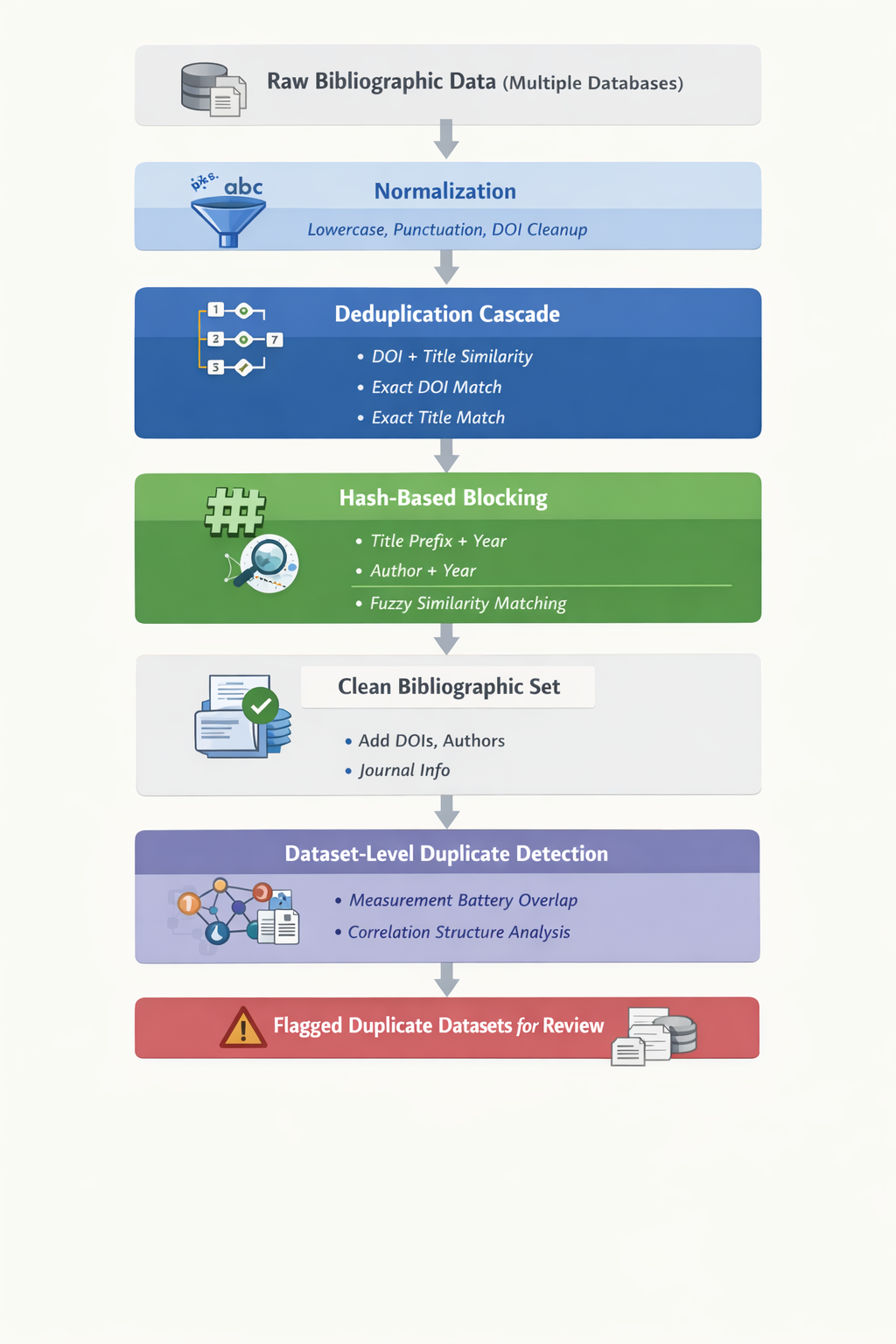
The system operates at two distinct levels. The first handles standard bibliographic deduplication (identifying duplicate papers). The second introduces a novel capability unique to HubMeta: dataset-level deduplication (identifying the same underlying data published across different studies). While traditional tools stop at the bibliographic level, analyzing both layers is absolutely necessary to ensure the evidence in your meta-analysis is truly independent.
Part I: Bibliographic Deduplication
The bibliographic deduplication system is built around three core design constraints:
- Precision precedes recall: Early stages remove only high-confidence duplicates.
- Gradual computational escalation: Cheap deterministic checks eliminate obvious duplicates before complex fuzzy similarity comparisons begin.
- Skepticism of persistent identifiers: Metadata errors are common across multiple databases, so identifiers cannot be trusted blindly.
These constraints inform our cascaded deduplication architecture.
Stage 1: Metadata Normalization
Before any matching occurs, bibliographic metadata must be neutralized to prevent trivial formatting differences from creating false mismatches. This normalization phase includes converting text to lowercase, removing punctuation, standardizing whitespace, cleaning DOI formatting, and normalizing author name fields.
Stage 2: The Multi-Step Cascade
The core matching system proceeds through a sequence of increasingly flexible checks. Each stage removes duplicates efficiently before moving on to computationally expensive operations.
| Step | Matching Strategy | Criteria for Duplication |
|---|---|---|
| 1 | Cautious DOI Matching | Normalized DOIs match AND normalized titles exhibit moderate similarity (Jaccard similarity > 0.5). |
| 2 | Direct DOI Matching | Identical normalized DOIs (captures remaining high-confidence matches). |
| 3 | Exact Title Matching | Identical normalized titles (captures duplicates lacking DOIs or with incomplete exports). |
Stage 3: Hash-Based Similarity Matching
Minor title or author variations require fuzzy matching. Comparing every record against every other record produces quadratic complexity, making it infeasible for large datasets. Instead, our pipeline utilizes blocking strategies to restrict comparisons to plausible candidate sets.
Strategy A (Title Prefix + Year) Records are grouped by the first three words of the normalized title and the publication year. Duplicates are flagged when title similarity exceeds a high threshold, or when combined title and author similarity is sufficient.
Strategy B (Author + Year) Records are grouped by normalized first author and publication year. Title similarity is then computed within these blocks to catch duplicates that evade title-prefix grouping.
Metadata Enrichment with OpenAlex
A major challenge in bibliographic deduplication is metadata sparsity. Missing DOIs, truncated author lists, abbreviated journal names, and inconsistent publication years make reliable comparison difficult.
To address this, our system can optionally enrich records using OpenAlex, an open scholarly database containing large-scale publication metadata. When sufficient identifying information exists, the pipeline queries OpenAlex to retrieve canonical titles, complete author lists, corrected DOIs, standardized journal identifiers, and verified publication years.
Duplicate detection performs best when multiple independent identifiers are available. By strengthening the signals available for detection, enrichment drastically improves both precision (fewer false positives) and recall (fewer missed duplicates).
Sources That Benefit Most from Enrichment
- Google Scholar: Broad coverage but sparse metadata, missing DOIs, and truncated titles.
- Lens.org: Integrates publications with patents but can contain incomplete publication data.
- Dissertation Databases: Repositories like ProQuest frequently lack persistent identifiers.
- Older Bibliographic Records: Legacy entries in premium databases may simply lack modern metadata fields.
Part II: Detecting Duplicate Datasets
Bibliographic deduplication solves only part of the problem. In meta-analysis, the more dangerous issue is duplicate datasets appearing across multiple distinct papers.
Examples include:
- A dataset reported in both conference and journal versions
- A longitudinal dataset reused across multiple articles
- Subsamples reported in separate studies
- Multiple papers utilizing the same underlying survey data
These cases cannot be detected using bibliographic metadata alone.
To solve this, we implemented a secondary pipeline that analyzes the measurement batteries and correlation structures within the meta-analytic dataset itself. Two studies using the same dataset will typically measure the same variables and report highly similar correlations among them.
The Dataset Detection Pipeline
Step 1: Measurement Battery Construction
For each sample, the system constructs a measurement battery consisting of all measured constructs or variables.
Step 2: Battery Overlap Detection
To dramatically reduce the number of pairwise comparisons, the system first groups samples by overlapping author lists. Within these blocks, candidate dataset duplicates are identified when two samples share substantial measurement overlap, based on the minimum number of shared measures and the Jaccard similarity between measurement sets.
Step 3: Edge-Level Correlation Comparison
To confirm potential duplication, the system evaluates the correlation structure between candidate samples. Shared variable pairs (edges) are compared using:
- Raw correlation differences (Δr)
- Fisher-z transformed differences (Δz)
- Chi-square discrepancy statistics per edge
If two samples share many edges and their correlations are nearly identical, duplication is highly plausible.
Interpretable Outputs for Manual Verification
To facilitate the final human-in-the-loop review, the pipeline generates a clean workbook to help researchers verify underlying datasets.
| Output Tab | Description |
|---|---|
| Dup datasets | Candidate duplicate datasets with clear explanations and full paper identification. |
| Dup Bat+LLR | Summary statistics for pairs flagged through battery overlap and correlation similarity. |
| Dup Bat+LLR details | Edge-level comparisons showing exact correlation differences between samples. |
Addendum: A Comparative Review of Deduplication Tools
It is worth asking why standard tools fail at large-scale deduplication. When shopping for evidence synthesis software, researchers should understand what happens under the hood of the most popular platforms.
Desktop Reference Managers (EndNote, Zotero, Mendeley)
The Method: Relies primarily on exact or near-exact field matches (Title, Author, Year, Reference Type).
The Verdict: Great for personal libraries or small reviews. However, these tools were not designed with the scaling challenges of large multi-database meta-analyses in mind. They lack scalable blocking strategies designed for very large corpora, and their reliance on pristine metadata guarantees they will miss fuzzy duplicates originating from messy databases.
Covidence
The Method: An automated, "black box" algorithm upon import that leans heavily toward exact string matching. Because the exact parameters of how it filters evidence are hidden from the user, this lack of transparency is fundamentally anathema to the open science movement and reproducible research.
The Verdict: The algorithm is intentionally conservative, prioritizing the avoidance of false positives. As a result, duplicates with minor metadata differences frequently remain in the dataset. Users often discover these later in the screening process, forcing them to manually clean up the algorithm's mess mid-review.
Rayyan
The Method: Calculates a Levenshtein-based "Similarity Percentage" between records and flags them for manual review. Automatic resolution is kept behind a premium paywall.
The Verdict: While more transparent than Covidence, it relies strictly on imported records and standard text similarity. It does not enrich broken metadata via external tools like OpenAlex, meaning incomplete imports stay incomplete.
Academic & Open-Source Solutions (ASySD, SRA-DM)
The Method: Rule-based deduplication algorithms designed specifically for systematic reviews, utilizing configurable thresholds, combinations of DOI/Year/Author, and fuzzy title matching.
The Verdict: These represent some of the best existing academic solutions for bibliographic deduplication and offer much-needed transparency. However, they are still limited to operating purely at the bibliographic metadata level.
The Missing Link: Dataset Duplication
Crucially, all of the above tools are completely blind to dataset-level duplication. If the exact same survey data is published under two different titles by two different author groups, EndNote, Covidence, Rayyan, and even advanced tools like ASySD will score it as a non-match and pass it directly into your analysis.
HubMeta is one of the only systems designed to catch these methodological ghosts by comparing underlying correlation matrices and measurement batteries to detect statistical reuse across studies.
Conclusion
Large-scale evidence synthesis requires infrastructure that goes well beyond traditional reference-manager tools. After all, the golden rule of a pristine evidence base should be: don't make me repeat myself. By combining aggressive metadata normalization, cascaded bibliographic matching, hash-blocked similarity detection, OpenAlex enrichment, and structural dataset-level analysis, this layered architecture identifies duplicates efficiently without sacrificing accuracy.
For small reviews, simple deduplication may be sufficient. But in the realm of large-scale meta-analysis, deduplication is not clerical work. It is a vital component of the analytic pipeline that directly protects the statistical integrity—and the independence—of your findings.
Cite HubMeta
To cite HubMeta in your research, use:
Steel, P., & Fariborzi, H. (2024). A longitudinal meta-analysis of range restriction estimates and general mental ability validity coefficients: Fisher addressing overcorrection and decline effects. Journal of Applied Psychology. Advance online publication. https://doi.org/10.1037/apl0001214
Ready to streamline your systematic review? Start using HubMeta for free today.